Introduction

This guide simplifies the process of installing MikroTik Router OS on a VPS. By automating the installation with a script, there’s no need to manually enter commands in the MikroTik CLI console. Once complete, you’ll have a fully operational VPS running MikroTik Router OS.

Getting Started: Prerequisites and VPS Preparation

Open a terminal and create a script file:
nano mikrotik.sh
Copy and paste the following script into the file
Script
#!/bin/bash
set -euo pipefail

# Include sbin paths
export PATH="$PATH:/usr/bin:/bin:/usr/sbin:/sbin"

# Auto-detect target disk (vda vs sda)
if [ -b /dev/vda ]; then
  export TARGET_DISK=/dev/vda
elif [ -b /dev/sda ]; then
  export TARGET_DISK=/dev/sda
else
  echo "ERROR: Neither /dev/vda nor /dev/sda found. Available disks:" >&2
  lsblk -d -o NAME,SIZE,TYPE >&2
  exit 1
fi
echo "Using TARGET_DISK=$TARGET_DISK"

sudo apt-get update && sudo apt-get upgrade -y
# add parted for partprobe; util-linux provides fdisk
sudo apt-get -y install gzip unzip curl wget util-linux ca-certificates parted

# Latest stable RouterOS v7
latest_version="$(curl -fsSL https://download.mikrotik.com/routeros/NEWESTa7.stable | awk '{print $1}')"

# CHR RAW disk image
ZIP="chr-${latest_version}.img.zip"
IMG="chr-${latest_version}.img"
download_url="https://download.mikrotik.com/routeros/${latest_version}/${ZIP}"

# Download + extract
wget -O "$ZIP" "$download_url"
rm -f "$IMG"
unzip -o "$ZIP" "$IMG"

# Attach image with partition scan
LOOP="$(sudo losetup --find --show --partscan "$IMG")"
sudo udevadm settle 2>/dev/null || true
lsblk "$LOOP"

cleanup() {
  set +e
  sudo umount /mnt/image 2>/dev/null || true
  sudo losetup -d "$LOOP" 2>/dev/null || true
}
trap cleanup EXIT

# Mount partition for injection:
# Prefer p2 first (typically main filesystem) then p1
sudo mkdir -p /mnt/image
MOUNTED=0
for p in "${LOOP}p2" "${LOOP}p1"; do
  [ -b "$p" ] || continue
  if sudo mount "$p" /mnt/image 2>/dev/null; then
    if sudo sh -c 'touch /mnt/image/.writetest && rm -f /mnt/image/.writetest'; then
      MOUNTED=1
      echo "Mounted writable partition: $p"
      break
    fi
    sudo umount /mnt/image
  fi
done

if [ "$MOUNTED" != "1" ]; then
  echo "ERROR: Could not mount a writable partition inside CHR image ($IMG)." >&2
  exit 1
fi

sync
sudo umount /mnt/image
sudo losetup -d "$LOOP"
trap - EXIT

# Write CHR image to disk
echo u | sudo tee /proc/sysrq-trigger >/dev/null
sudo dd if="$IMG" bs=4M of="$TARGET_DISK" status=progress conv=fsync
sudo sync

# Verify layout best-effort
sudo partprobe "$TARGET_DISK" 2>/dev/null || true
lsblk "$TARGET_DISK" || true
sudo fdisk -l "$TARGET_DISK" 2>/dev/null || true

echo s | sudo tee /proc/sysrq-trigger >/dev/null

echo "Waiting 5 seconds..."
end_time=$((SECONDS + 5))
while [ $SECONDS -lt $end_time ]; do :; done

echo "Reboot OS"
echo b | sudo tee /proc/sysrq-trigger >/dev/null
Press CTRL+O to save your changes, then exit by pressing CTRL+X.

Set Script Permissions

Set the script execution rights:
chmod +x mikrotik.sh
chmod 755 mikrotik.sh

Run the Script

./mikrotik.sh
The VPS will reboot automatically once the installation completes.

Install settings manually in RouterOS

  1. Login to your VPS Management Portal
  2. Locate your VPS from the Services tab
  3. Enable VNC Server
  4. Open the noVNC or connect by VNC client
  5. Login to the Router OS using admin account and blank password
  6. Setup new password for admin account
  7. Show the name of interfaces:

Check name of interface
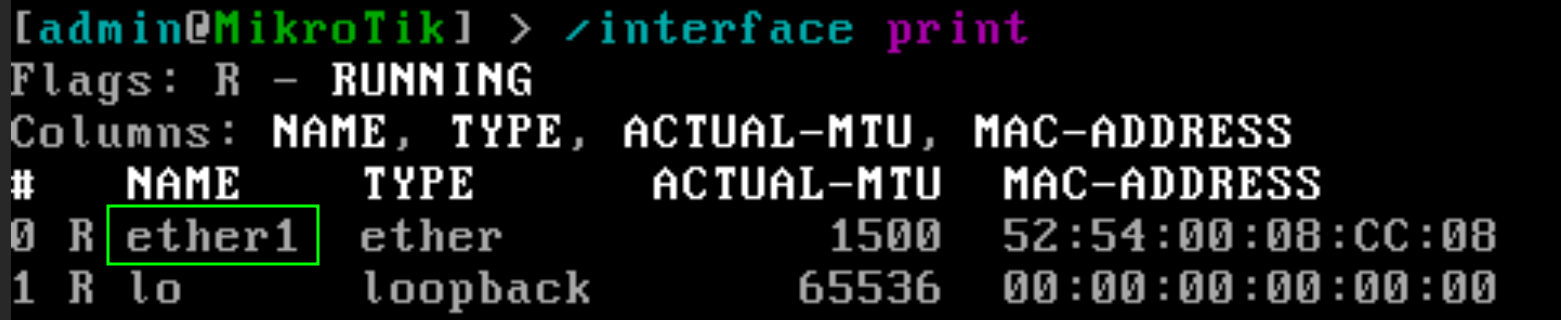
Check name of interface in RouterOS
/interface print
  1. Check you Network Information in the billing panel. Configure your IP address of the server (192.168.1.100 - IP address of the server & ether1 - name of interface):
 /ip address add address=192.168.1.100/24 interface=ether1 
  1. Configure gateway(192.168.1.1 - IP address of gateway):
/ip route add gateway=192.168.1.1 dst-address=0.0.0.0/0
  1. Configure DNS:
/ip dns set servers=1.1.1.1,1.0.0.1
After you have finished configuring Router OS in VNC,Connect to MikroTik Router OS using Winbox.

Connecting to Server Using Winbox

  1. Download and Install Winbox from the MikroTik website.
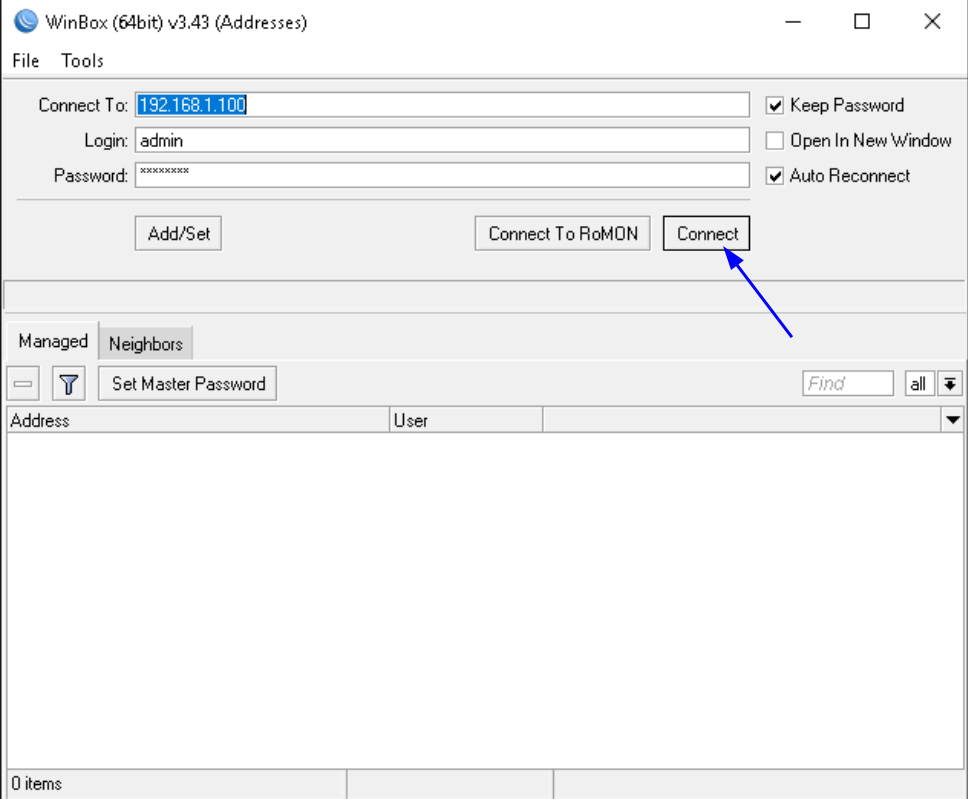
  2. Open Winbox and create a new connection: • Enter your VPS IP address. • Use admin for the Login field and Enter the Password that you installed before.
    • Click Connect. Install MikroTik RouterOS
Congratulations! MikroTik Router OS is now successfully installed and operational on your VPS. With the automated script, accessing and managing Mikrotik CHR via Winbox is quick and efficient. After securing your credentials and testing the setup, your infrastructure setup is ready for seamless network management.